- How Big Should Your Solar Battery and System Be?
- How solar battery storage works
- Introduction to solar battery storage
- Tesla Powerwall battery solutions
- What Do Solar Batteries Look Like – and Where Can I Install Them?
- What Size Solar System Should You Have When Adding a Battery
- What’s the Real ROI on Solar and Battery Systems in 2025?
- When are batteries worth it? Solar energy battery viability.
- Which Solar Battery Is Right for Your Home?
- Does Solar Increase Property Value in Shoalhaven? The Numbers Speak for Themselves
- Empowering Small Businesses with Solar: The Australian Small Business Energy Incentive
- How Can Solar and Battery Solutions Help You Manage Electricity Rate Price Increases?
- How much will you save with solar?
- How the 2025 Australian Cheaper Home Batteries Program Works
- Solar finance options
- The 2024 NSW Government Home Solar Battery Rebate Scheme
- What government incentives and financing options are available for solar?
- What Is the Solar Sharer Offer and Could It Lower Your Power Bills?
What Is the Solar Sharer Offer and Could It Lower Your Power Bills?
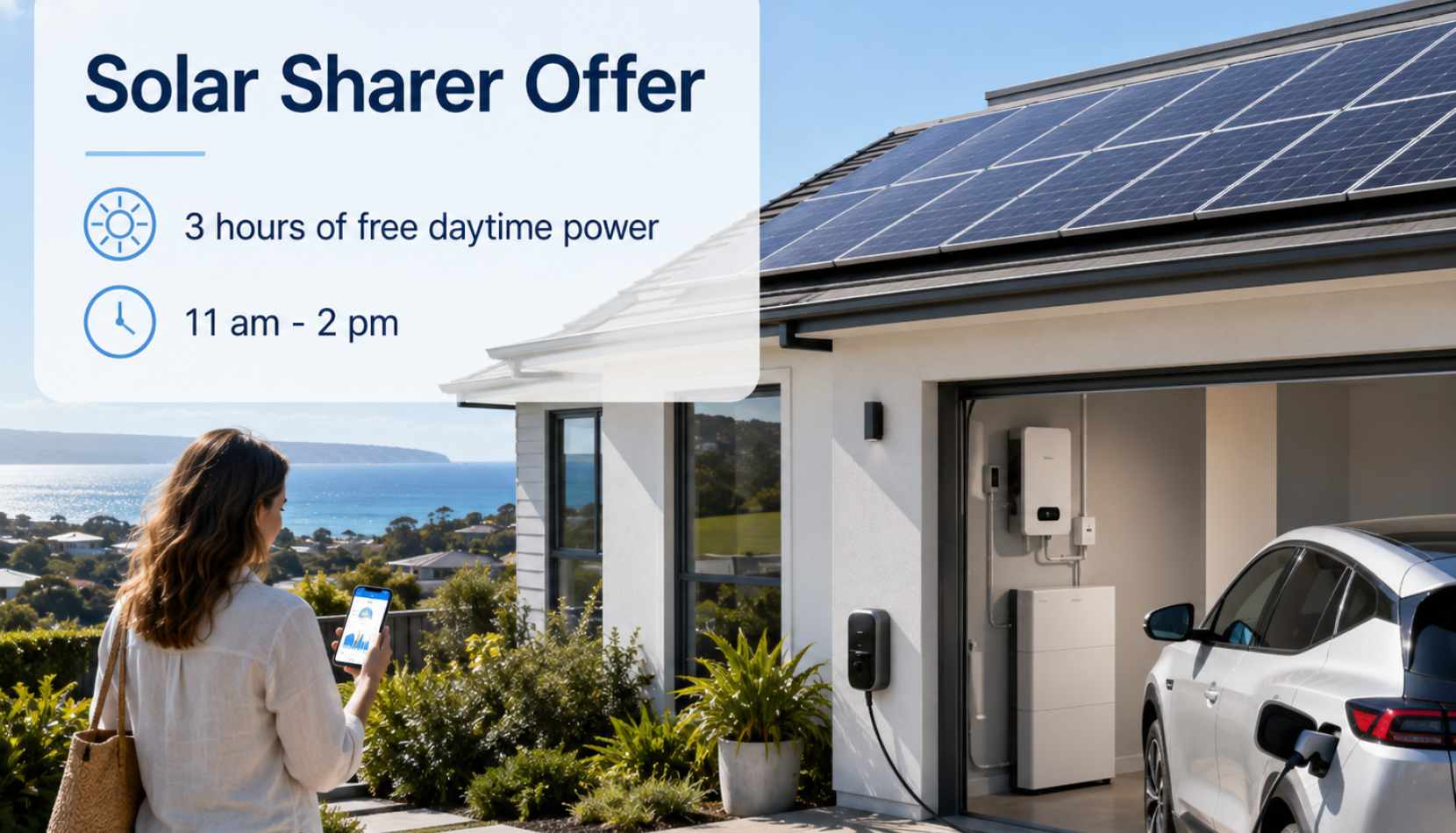
From 1 July 2026, eligible households across New South Wales can opt into a new electricity plan offering three hours of free electricity every day.
Known as the Solar Sharer Offer, the plan is designed to make better use of Australia’s abundant daytime solar generation. Importantly, you do not need solar panels on your own roof to participate.
For households in the Shoalhaven and Southern Highlands, the free electricity period runs from 11 am to 2 pm every day, throughout the year.
However, the plan will not automatically save every household money. The greatest benefits will go to people who can shift a meaningful amount of their electricity use into those three hours.
What Is the Solar Sharer Offer?
The Solar Sharer Offer is an opt-in regulated electricity plan available to eligible residential customers in:
New South Wales
South Australia
South East Queensland
Under the offer, NSW households can use up to 24 kilowatt-hours of electricity free of usage charges between 11 am and 2 pm each day.
That is a generous allowance for most households. According to the Australian Energy Regulator, 24 kWh is approximately the amount of electricity an average five-person household uses across an entire day.
Electricity used above the 24 kWh allowance during the free period is charged at the plan’s applicable reasonable-use rate.
The Solar Sharer Offer is available to households with or without rooftop solar. Its purpose is to encourage more people to use electricity when renewable generation is plentiful, rather than during the more expensive morning and evening peak periods.
When Is Electricity Free in NSW?
For homes in the Shoalhaven, Southern Highlands and elsewhere in NSW, the free electricity period is:
11 am to 2 pm every day
The time remains the same throughout the year from the customer’s perspective, including during daylight saving.
The first 24 kWh of electricity used during that window is free. However, you will still pay:
Your daily electricity supply charge
Electricity usage outside the free period
Controlled-load charges, where applicable
A usage charge if you exceed 24 kWh during the free period
This means the Solar Sharer Offer should not be viewed as “free electricity all day”.
It is a particular type of time-of-use plan that rewards households for concentrating more of their energy use into the middle of the day.
Who Is Eligible for the Solar Sharer Offer?
To be eligible in NSW, you generally need to:
Be a residential electricity customer
Have a smart meter installed
Live in an area covered by the Default Market Offer
Receive electricity directly from an eligible retailer
Not be supplied through an embedded network
Both homeowners and renters can be eligible. You also do not need to own rooftop solar or a home battery.
Larger energy retailers operating in eligible regions are required to make a Solar Sharer Offer available. However, retailers with 1,000 or fewer customers across the relevant regions may be exempt.
You will not be automatically moved onto the plan. You need to contact an electricity retailer and actively choose to opt in.
Do You Need Solar Panels to Access the Offer?
No. Despite its name, the Solar Sharer Offer is available to eligible households whether or not they have rooftop solar.
The idea is that households without their own panels can share in the benefits of the large amount of inexpensive renewable electricity available across the grid during the middle of the day.
For households that already have solar, however, the value of the offer may be more complicated.
Between 11 am and 2 pm, your own solar panels may already be producing enough electricity to cover most of your household consumption. Free grid electricity has limited value when you are already generating free electricity on your roof.
The offer may become more valuable for a solar household if it can be used to:
Charge a home battery from the grid
Charge an electric vehicle
Run several large appliances simultaneously
Supply additional electricity when household demand exceeds solar production
Preserve stored solar energy for later use
The right approach depends on your solar system, battery settings, electricity plan and household usage pattern.
How Can You Make the Most of Three Free Hours?
The Solar Sharer Offer works best when you deliberately move energy-intensive activities into the 11 am to 2 pm window.
Run Larger Appliances During the Day
Appliances that may be suitable include:
Washing machines
Clothes dryers
Dishwashers
Electric ovens
Pool pumps
Reverse-cycle air conditioning
Electric vehicle chargers
Many modern appliances include delay-start functions. These can allow you to load the dishwasher or washing machine in the morning and schedule it to begin after 11 am.
Always follow the manufacturer’s safety advice and avoid leaving appliances running unattended where this is not recommended.
Heat or Cool Your Home Before the Evening Peak
Instead of waiting until late afternoon to turn on your air conditioning, you may be able to pre-cool or pre-heat your home during the free period.
A well-insulated home can retain some of that temperature into the evening, reducing the amount of expensive electricity required later.
Charge Your Electric Vehicle
Electric vehicle charging can consume a substantial amount of electricity, making it one of the clearest opportunities to benefit from the plan.
A suitably configured home charger can be programmed to charge between 11 am and 2 pm.
The amount of energy added will depend on the charger, the vehicle and the available electrical capacity of the property.
Review Your Hot Water Setup
Electric hot water is often one of the largest energy users in a home.
However, a hot water system connected to a controlled-load circuit may continue to be billed separately and may not receive free electricity under the offer.
A qualified electrician or solar energy specialist can assess whether your hot water system can be safely and economically configured to make better use of daytime power.
Can You Charge a Solar Battery During the Free Period?
Yes, provided your battery system and electricity plan allow grid charging.
A compatible home battery may be programmed to charge from the grid during the free period. You can then use the stored electricity later in the afternoon or evening, when electricity rates are higher.
In simple terms, the battery can help move free daytime grid electricity into a time when it is more valuable.
This could be particularly useful during winter, extended cloudy weather or on days when your solar panels do not generate enough energy to fully charge the battery.
However, several factors need to be considered:
Whether the battery permits grid charging
Battery charging and discharging losses
The cost of electricity outside the free period
Battery capacity and remaining storage space
Warranty conditions
Your existing solar production
Whether automated charging settings are available
Solar battery storage is most effective when the system is properly sized and configured around the household’s actual energy consumption.
Shoalhaven Solar recommends individually designed systems, high-quality battery equipment and reliable monitoring technology to help customers use more of their energy when it provides the greatest value.
Could the Solar Sharer Offer Make Batteries More Attractive?
For some households, yes.
Traditionally, home batteries have been charged using surplus rooftop solar. Under the Solar Sharer Offer, eligible households may have another opportunity to charge a compatible battery using free grid electricity between 11 am and 2 pm.
A household could potentially:
Use its rooftop solar to power the home.
Use free grid electricity to charge the battery where appropriate.
Save the battery’s stored energy for the evening.
Reduce electricity purchases during more expensive peak periods.
This does not mean every household should install a battery purely to access the Solar Sharer Offer.
Battery value still depends on the installation cost, available incentives, system lifespan, warranty, energy consumption and electricity tariffs.
However, the offer adds another factor that may improve the financial calculation for homes that were already considering solar battery storage.
Is the Solar Sharer Offer Guaranteed to Save You Money?
No. This is the most important point to understand.
Electricity outside the free period is charged under a time-of-use structure, and some of those rates can be higher than the rates on a conventional electricity plan.
The daily supply charge also continues to apply.
The Australian Energy Regulator has warned that households with usage patterns different from its modelled assumptions may not save money.
Customers who are already on a competitive market offer may also be worse off after switching, even if they move some consumption into the free period.
The plan may not suit you if:
Most of your electricity use occurs before 11 am or after 2 pm
You use substantial electricity during the evening peak
You cannot schedule or automate your appliances
You already receive a highly competitive electricity rate
Your own solar system already covers nearly all midday demand
Your controlled-load appliances cannot access the free period
The headline of “three hours of free electricity” is appealing, but the whole plan must be assessed.
What Should You Compare Before Signing Up?
Before changing plans, check the following details carefully.
Rates Outside the Free Period
Look at the peak, shoulder, off-peak and solar-soak rates.
These may have a greater effect on your total bill than the free period.
The Daily Supply Charge
This fixed daily charge still applies, regardless of how much electricity you use.
Your Current Electricity Usage
Smart-meter data can show when your household consumes the most energy.
Comparing a full 12 months of usage will usually provide a more accurate picture than relying on one recent bill.
Your Existing Solar Exports
If you already have solar, check how much energy you generate and export between 11 am and 2 pm.
This will help determine whether free grid power would provide much additional value.
Your Feed-In Tariff
Changing electricity plans could also affect the rate you receive for surplus solar exported to the grid.
A lower feed-in tariff may offset some of the savings from free electricity.
Controlled Loads
Confirm whether hot water, pool equipment or other controlled-load appliances are excluded from the free period.
The Australian Government’s Energy Made Easy website can be used to compare the Solar Sharer Offer with other available electricity plans.
Entering your National Metering Identifier may allow the comparison to use your previous 12 months of consumption.
Solar Sharer Offer, Solar Panels or a Battery: Which Saves More?
These options are not necessarily alternatives. They can work together.
Rooftop solar generates electricity throughout the day and can reduce the amount of power you purchase from your retailer.
A solar battery stores energy for use after the sun goes down, helping reduce evening grid consumption.
The Solar Sharer Offer provides a three-hour window in which eligible households can use grid electricity without usage charges, subject to the 24 kWh daily limit.
The best combination depends on when you use electricity.
For example, a household with high evening consumption may benefit from solar panels and a battery, while a household without solar that can charge an electric vehicle during the day may gain substantial value from the Solar Sharer Offer alone.
A household with solar, a compatible battery and smart energy controls may be able to take advantage of all three.
Frequently Asked Questions
When Did the Solar Sharer Offer Begin?
The Solar Sharer Offer became available in eligible regions from 1 July 2026.
What Are the Free Electricity Hours in NSW?
The free period is 11 am to 2 pm every day, including weekends and public holidays.
Is the Electricity Completely Unlimited?
No. The first 24 kWh used during the three-hour period is free.
Electricity used above that allowance is charged at the applicable reasonable-use rate.
Does the Solar Sharer Offer Include the Daily Supply Charge?
No. The retailer’s daily supply charge continues to apply.
Can Renters Access the Offer?
Yes. Eligible renters and homeowners can opt in, provided the property has a smart meter and is not supplied through an excluded embedded network.
Can I Access the Offer Without Solar Panels?
Yes. You do not need rooftop solar.
Can I Charge My Battery From the Grid for Free?
Potentially. Your battery, inverter and retailer plan must support grid charging, and the system must be configured correctly.
Will I Lose My Solar Feed-In Tariff?
Not necessarily, but the applicable feed-in tariff may change when you change electricity plans.
Ask the retailer to confirm the export rate before signing up.
How Do I Join the Solar Sharer Offer?
Contact your electricity retailer, confirm your eligibility and ask for the full rates and comparison price.
You can also compare participating plans through Energy Made Easy.
Could the Solar Sharer Offer Change Your Battery Calculation?
If you previously decided that a solar battery did not quite make financial sense, it may be worth reviewing the numbers.
The Solar Sharer Offer, the Australian Government’s battery incentives and current NSW energy-upgrade programs may change the upfront cost and ongoing savings available to your household.
The right battery can also provide greater energy independence and, when properly configured, backup power during an outage.
However, these benefits depend on choosing the right equipment and designing the system around your real electricity usage.
Shoalhaven Solar can assess your existing solar system, smart-meter data and electricity consumption to determine whether a new battery, expanded battery system or updated energy-management setup is suitable for your home.
Contact Shoalhaven Solar today at (02) 4464 1597 for your personalised solar energy solution.
Suggested Articles
- Does Solar Increase Property Value in Shoalhaven? The Numbers Speak for Themselves
- Empowering Small Businesses with Solar: The Australian Small Business Energy Incentive
- How Can Solar and Battery Solutions Help You Manage Electricity Rate Price Increases?
- How much will you save with solar?
- How the 2025 Australian Cheaper Home Batteries Program Works
- Solar finance options
- The 2024 NSW Government Home Solar Battery Rebate Scheme
- What government incentives and financing options are available for solar?
Start saving today. Get your solar installed by Shoalhaven Solar.
